
Escaliers intérieurs · Practical advice
Stairs on a central beam: lightness and visual character
A central-beam staircase rests on a single load-bearing beam, visible beneath the treads, rather than on two side stringers. This construction principle creates an impression of lightness and frees up the sides of the stair.
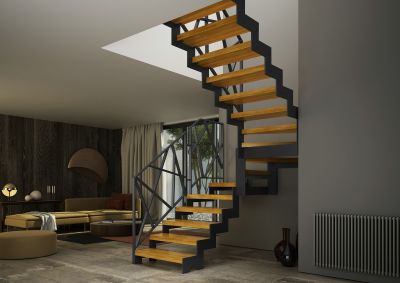
The construction principle of the central beam
The central beam, in steel or wood depending on the model, supports all the treads from the middle of their width. The treads appear to float on each side, with no visible stringer at the edges. This principle particularly suits contemporary interiors seeking a discreet structure.
Faro, Revo, Formia and Revo Slim: distinct approaches
Among the central-beam models offered by Lux Art, Faro, Revo and Formia each express a distinct aesthetic, from more solid to more refined. Revo Slim takes this further with a slimmer beam, designed for spaces where visual lightness is a priority. The choice depends on the desired style and the room layout.
Which interiors suit this type of staircase well?
A central-beam staircase stands out well in an open-plan room, where the structure remains visible from several angles. It also suits renovations seeking a strong visual effect without weighing down the space. In a small volume, a more discreet model like Revo Slim helps preserve a sense of openness.
Points to check before choosing this construction principle
The sizing of the central beam depends on the span, material and expected load, and must be assessed for each project. It also helps to think about the matching handrail and balustrade, which should complement the structure's lightness rather than contradict it visually.