
Pergolas · Practical advice
How does a bioclimatic pergola work?
A bioclimatic pergola works through a simple yet precise mechanism: pivoting louvres adjusted manually or by remote control, combined with smart rainwater management. Understanding this mechanism helps you choose the options that are genuinely useful for your terrace.
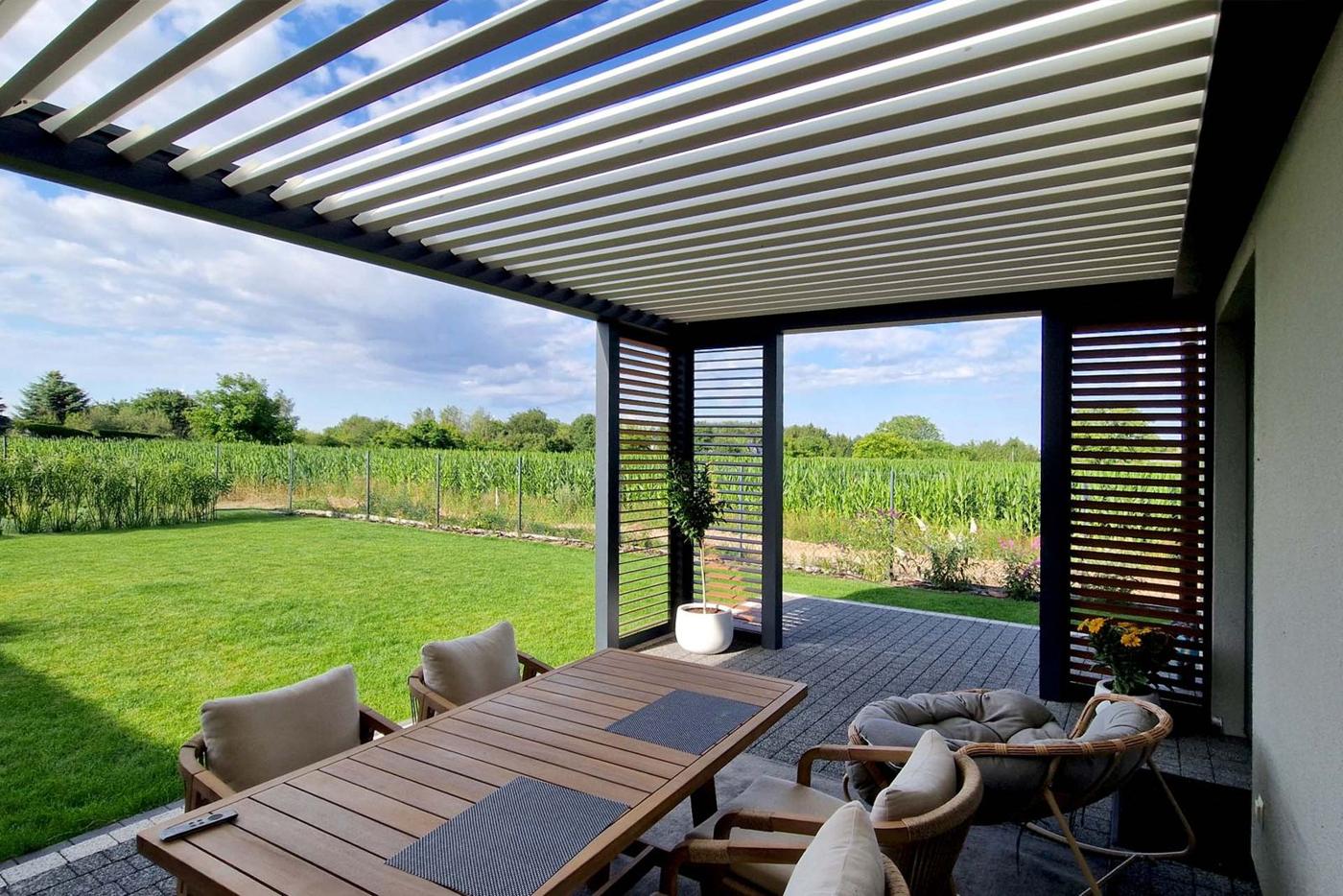
Louvre rotation, step by step
Each louvre rotates on a central axis up to around 150°, depending on the model. Closed, the louvres overlap to form an almost watertight roof. Open, they create gaps between each louvre to let air and light through. Between these two extremes, countless intermediate settings let you precisely dial in shade and ventilation depending on the time of day or sun position.
Manual or motorised control
Depending on the model chosen, louvre orientation is controlled via a hand crank, a remote control, or a connected app driving an electric motor. Motorisation allows programmed scenarios, such as automatically closing the louvres in case of rain if a rain sensor is installed. This level of automation is an equipment choice to define according to the intended use of the pergola.
Rainwater management
A major advantage of the bioclimatic pergola is collecting rainwater directly into the posts via gutters integrated into the roof. Even with closed louvres, water does not pool on the structure: it is channelled and discreetly drained away, preventing any seepage onto the terrace. This system also protects the aluminium structure itself, which remains resistant to corrosion and UV over time.
Adapting to each project
The technical operation stays the same from project to project, but every Lux Art Dream Design bioclimatic pergola is sized and equipped according to actual needs: surface to cover, wind exposure, chosen side closures. A 3D Flexijet survey confirms exact dimensions before manufacturing, ensuring smooth louvre operation from installation and over the long term.